How Prior Auth Lookup works
Overview
Some payers want to approve certain procedures, scans or drugs before they happen. If the practice skips that approval, the payer can refuse to pay, even when the care was right. Prior Auth Lookup shows the front desk what the payer has published about a code for a given payer, plan type, state and date of service.
Every answer shows its source, the list date, when we last checked it and how confident we are. When we have no evidence we say Unknown. No answer is a prior auth determination: verify with the payer before scheduling.
Getting started
- In Lookup, search for the payer and pick it from the list. Payers marked Official list have a published prior auth code list loaded; the line under the name shows the plan types and states it covers. Payer policies only means answers come from the payer policies we monitor.
- Pick the plan type, the state and the date of service.
- Type or paste one or more CPT or HCPCS codes. Press Enter, a comma or a space to add each one.
- Click Check prior auth.
Lookup
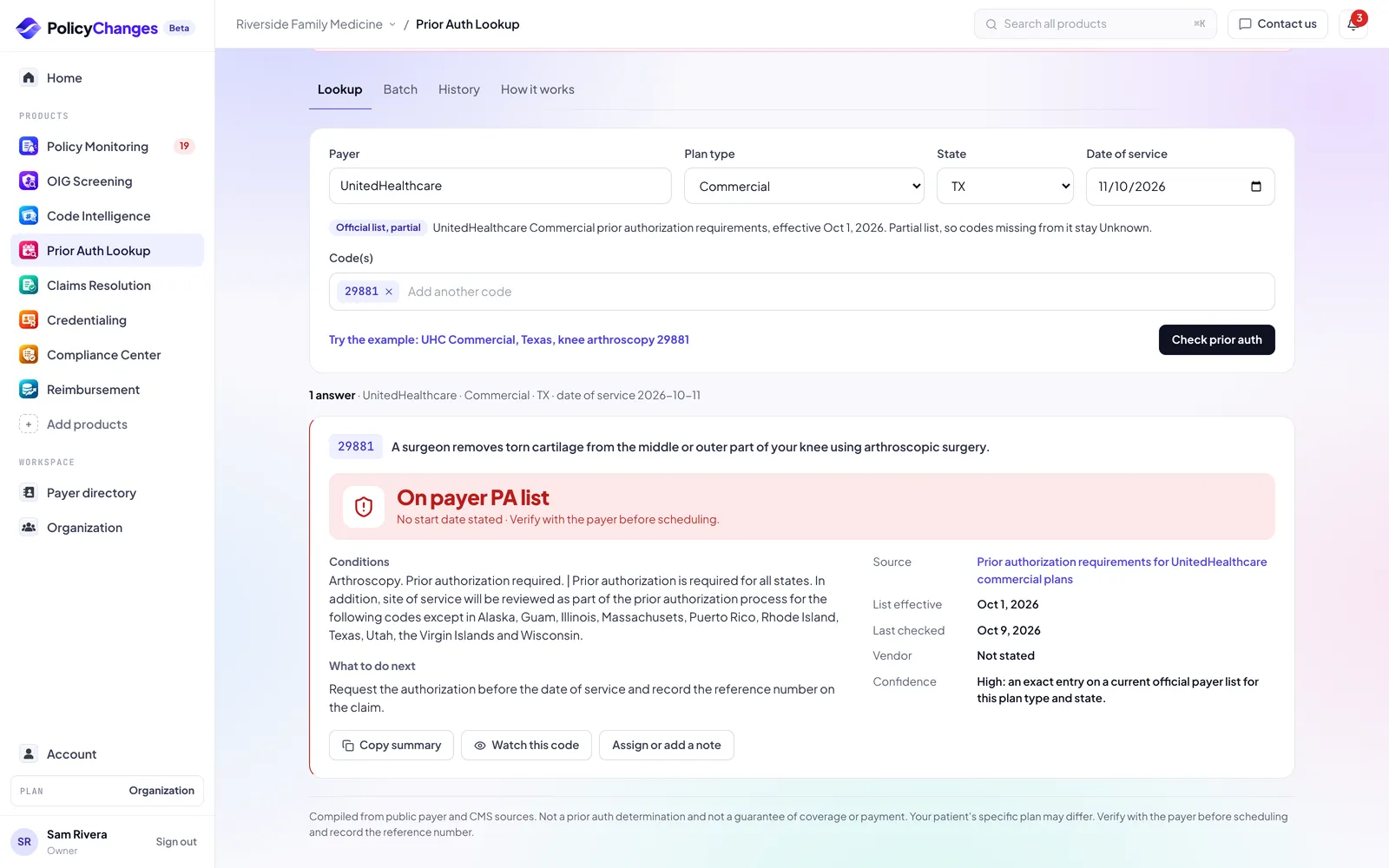
Under the form, a short note tells you where answers for that payer and plan come from: an official prior auth list with its effective date, or payer policies only. When the payer says its list is not exhaustive, codes missing from it stay Unknown.
Each result card shows the code and its description, the answer, since when, and the confidence. Below that: Why, any Conditions, the Source, List effective, Last checked, the Vendor that handles the request when there is one, and What to do next.
Copy summary puts a plain text summary on your clipboard, ready to paste into the patient's chart or a scheduling note.
Batch
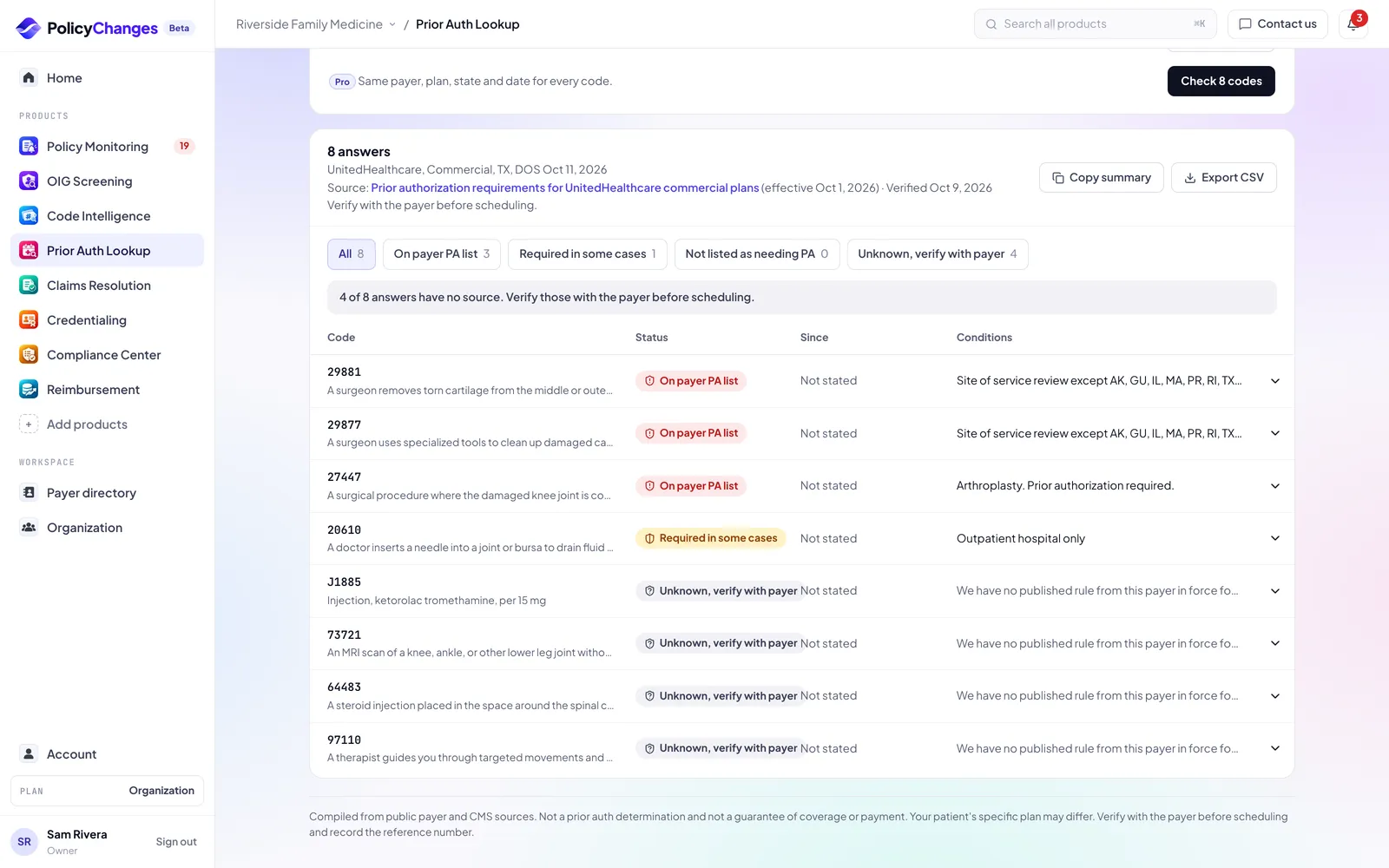
Batch checks up to 50 codes at once for the same payer, plan, state and date. Paste codes separated by commas, spaces or new lines, use the sample list, or upload a CSV.
Results come back as a table with Code, Status, Requirement start and Conditions. Filter by status with the chips, and click a row to see why, the conditions, next steps, the source and the confidence.
Copy summary copies a short list with the sources, ready to paste anywhere. Export CSV downloads every column, including source links and last checked dates, and ends with a disclaimer row.
History
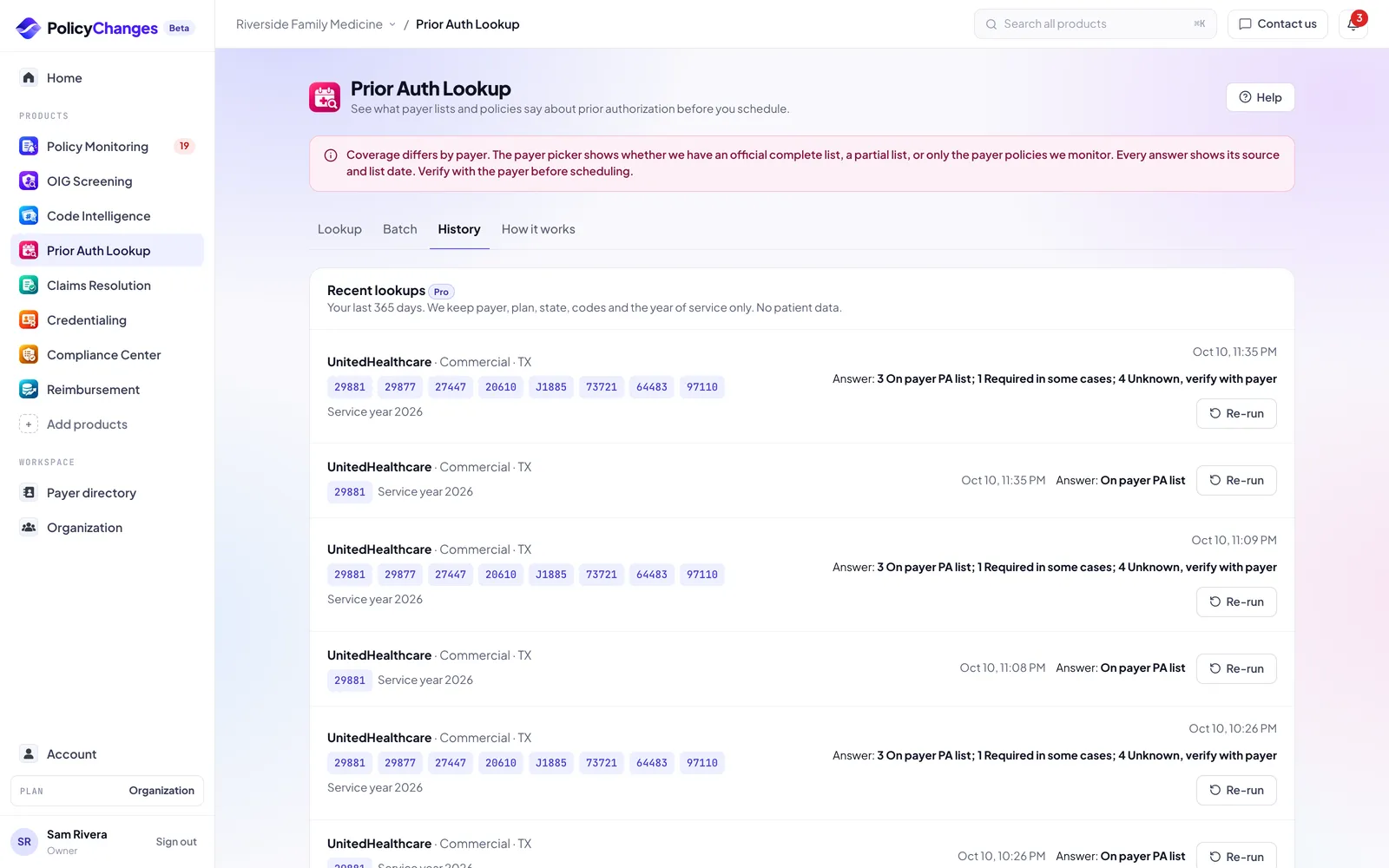
History shows your recent lookups with payer, plan, state, codes and the answer. Click Re-run to check the same lookup again with today's data.
We keep payer, plan, state, codes and the year of service only. No patient data.
How it works tab
The How it works tab inside the product explains prior authorization, the answers and where our data comes from, in plain words. It is a good page to share with new front desk staff.
How to read results
- On payer PA list
- The payer lists this code as needing prior auth for this plan, state and date. We show since when, the source and how to submit.
- Required in some cases
- The payer lists it only in some settings, with some diagnoses, or through a vendor program. The conditions are shown as the payer wrote them.
- Payer says not required
- The payer states in writing that this code does not need prior auth. We link the statement.
- Not on payer list (list dated MM/DD/YYYY)
- The code is missing from a complete, current list for that exact plan and state. Absence from a list is not a payer statement, and lists can be incomplete or out of date.
- Not on any Medicare PA program
- Traditional Medicare asks for prior auth only in specific programs with closed code lists. The code is on none of the ones that apply in your state.
- Not on [payer]'s published list dated MM/DD/YYYY
- The code is not on the payer list we have, but the payer says that list is not exhaustive, so this is not a no. Verify with the payer.
- Unknown, verify with payer
- We found no source for that code, plan type, state and date of service. Verify with the payer.
- No list for this plan and state yet
- We do not have this payer's prior auth list for that plan type and state yet. Ask the payer.
- Only in the payer's provider portal
- The payer publishes its prior auth list only behind a provider login. The answer names the portal and links to it so you can check there.
- Confidence
- High, Medium or Low. High needs a current official prior auth list for that plan and state. Answers based on a payer policy, an older list or a source with no start date are Medium at most, and Low when the evidence is thin. Unknown answers are always Low.
- Requirement start and List effective
- Requirement start is the date the payer gives for when the requirement started, shown only when the payer states one. List effective is the date the payer gives for the version of the list we used.
- Last checked
- The last time we checked the source. When it is older than 45 days, the card says so.
What each plan includes
- Free
- Live lookups: 3 lookups a day, one code each. Lookups that find no payer answer do not count.
- Basic and Pro
- Single and batch lookups and a year of lookup history. The 30-day Pro trial includes it.
Data sources and freshness
- Payer prior auth code lists
- Large payers publish lists of codes that need prior auth, by plan and state, often monthly. We load them and keep every version, so we know what changed and when.
- Payer policies
- Our policy feed covers more than 100 payers and is updated daily. When a payer announces that a code needs prior auth starting on a date, we capture the change, the date and the link.
- Medicare programs
- Traditional Medicare rarely uses prior auth, except for specific programs (hospital outpatient services, some equipment, repetitive ambulance trips and the WISeR model in a few states). Their code lists are closed, so a code on none of them shows as not on any Medicare PA program.
FAQ
- Why do I get Unknown so often for some payers?
- Those payers have no official list loaded for that plan, so answers rely on payer policies. The note under the form tells you which case you are in.
- Can I enter patient details?
- No, and you do not need to. A lookup only needs payer, plan, state, date and codes.
- The payer told me something different. Who is right?
- The payer. Record their answer and the reference number, and tell us so we can check our source.
Disclaimer
PolicyChanges aggregates information that payers and government agencies publish. We summarize it and link every answer to its source, but we do not create the rules and we can miss or misread a change.
Nothing here is legal, medical, coding or billing advice, and nothing here is a guarantee of coverage or payment. Your patient's specific plan, your contract and the payer's current rules decide the outcome.
Always verify with the payer before you act, and record the reference number or the source you relied on.
Features, limits and data coverage can change, and we welcome reports of anything that looks wrong.